Articles & Videos
Why is segmenting and blending important for systematic synthetic phonics?
Categories

Subscribe to our newsletters
Receive teaching resources and tips, exclusive special offers, useful product information and more!
Back to Planning articles & videos
Why is segmenting and blending important for systematic synthetic phonics?
Sound Waves 12/11/25
Please note: A new and improved Sound Waves Years 3–6 program is on its way for use in 2027! Information in our professional learning articles may differ in the updated edition.
We all agree students should be explicitly taught phoneme–grapheme relationships so they can apply this knowledge to their spelling and reading. As part of this instruction, students should spend time breaking words into sounds (segmenting) and putting sounds together to form words (blending).
To help you understand what these two essential skills involve and how they work in both spoken and written form, we’ve created a short video and accompanying article.
Watch our introduction video
This video provides a brief introduction to segmenting and blending skills.
Oral segmenting and blending
As part of your phonics lessons, it’s important to practise saying the 43 phonemes of Australian English, as this helps students avoid errors when they are segmenting.
Segmenting is first introduced as an oral exercise and involves breaking words into phonemes. To practise this in the classroom, ask students to:
- Say the word aloud (e.g. sun).
- Count the sounds, holding up one finger for each phoneme (e.g. /s/, /u/, /n/).
Blending can also be done as an oral exercise and involves joining phonemes together to make words. To practise blending with students, follow these steps:
- Say the sounds in a word (e.g. /s/, /u/, /n/).
- Ask students to put the sounds together and tell you the word (e.g. sun).
Segmenting and blending can be practised even before graphemes are introduced. Blending is easier than segmenting, so it’s a good place to start when introducing these skills to students.
Written segmenting and blending
Once you’ve practised oral segmenting and blending, students can begin using these skills when writing words.
Written segmenting strengthens students’ spelling by reinforcing the relationship between phonemes and graphemes.
To practise written segmenting with students, follow these steps:
- Say the word aloud (e.g. chin).
- Count the sounds, holding up one finger for each phoneme (e.g. /ch/, /i/, /n/).
- Write the number of phonemes.
- Write a grapheme to represent each phoneme.
- (Optional) Highlight the grapheme/s for the focus phoneme.
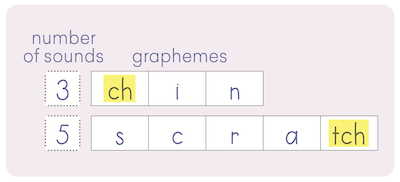
To practise blending, reverse the process of segmenting. Students look at a written word and identify each of the graphemes in the word and the phonemes that they represent. Students then blend the sounds together to read the word. This process highlights why blending is so useful for reading practice.
Students can practise blending as soon as they have learned enough graphemes to make a word. For example, as soon as a student has learned the phoneme–grapheme relationships m for /m/ and a for /a/, they are ready to blend the word am.
When are these skills used in Sound Waves?
Opportunities to practise segmenting and blending are embedded into each week’s lessons across all year levels of the Sound Waves program. Students are introduced to oral segmenting and blending in Week 4 of Foundation, then progress by adding written segmenting and blending from Week 6.
The program contains purpose-built tools and resources to help you teach these important skills and practise them with students. These resources include:
Segmenting Sheets: Available in Years 1 to 6 as a printable sheet in the Games and Extra Activities section of each unit, these sheets allow students to practise segmenting Focus and Extension Words. The Focus Word segmenting pages are also included at the back of each Student Book in Years 3 to 6 as a routine step in the lesson sequence.
Segmenting Tool: Available on both the teacher and student sites of Sound Waves Online, this tool can be projected for whole-class segmenting or used by students for independent practice.
Segment, Blend and Select: Available for Foundation teachers at Sound Waves Online, this whole-class interactive activity allows you to practise segmenting and blending words together.
Decodable Readers: Available for Foundation and Year 1, the Decodable Readers are used as projectable books by teachers for modelled reading, and as physical books or eReaders by students engaged in independent reading practice. Decodable Readers provide students with targeted reading practice of the phoneme–grapheme relationships they have been explicitly taught. The Decodable Readers are available in three levels of difficulty, so for every phoneme–grapheme relationship taught in the sequence, teachers can choose from a Support, Core or Extended book.
It’s not always easy, and that’s ok
When it comes to segmenting and blending some words are easier to apply these skills to than others.
Sometimes a word can be segmented in more than one way depending on pronunciation. For example, in the word often some people pronounce the /t/ while others do not, which will affect how someone represents the segmenting of that word. It’s important to communicate that, even when there are multiple ways to pronounce and segment a word – the spelling always remains the same. To find out more, read our article How pronunciation influences segmenting.
Furthermore, words can be trickier to segment if one grapheme actually represents two phonemes, or the word includes the schwa phoneme, or the word includes what’s referred to as a split digraph. To find out more about trickier words, read our article Tricks of the trade: Tackling words that are difficult to segment.
When differences in pronunciation or tricky words arise, it’s important not to get too caught up in what is exactly the ‘right’ or ‘wrong’ way to segment. Ultimately, these rich discussions about words and how they work help students to deepen their understanding of spelling.
If you and your colleagues want to focus on segmenting skills, as well as other key systematic synthetic phonics practices, contact your local Education Consultant to arrange a free professional learning workshop.