Articles & Videos
Why the goal of assessment should always be better learning outcomes
Categories

Subscribe to our newsletters
Receive teaching resources and tips, exclusive special offers, useful product information and more!
Back to Assessment articles & videos
Why the goal of assessment should always be better learning outcomes
Maths Trek 4/11/26

Australian maths results are under the spotlight. The Grattan Institute’s Maths Guarantee report1 found one in three students is failing to achieve proficiency in maths, and this year’s NAPLAN showed Year 3 numeracy at its lowest point since 2023.2
There’s plenty of talk about what needs to change. What gets less airtime is the assessment already happening in classrooms every day. NAPLAN tells us how students are tracking at one point in time. Classroom assessment tells us why, and what to do next.
Why does maths assessment matter?
Too often, assessment is treated as the final step, a grade recorded once the learning is done. But its real purpose is to improve learning. And if we want students to become confident, independent maths learners, they need to be active participants in understanding and evaluating their own progress, not passive recipients of a score.
Effective and purposeful assessment is so much more than a simple final grade. A single assessment offers only a limited view of what students are truly capable of. To generate the grades required by our education system, teachers must draw on a broad range of formative and summative measures. Beyond assigning a grade, teachers need to use assessment to provide feedback to students and parents, and to inform their own future teaching practice.
The Australian Association of Mathematics Teachers (AAMT) describes how excellent teachers assess student learning in their position paper ‘The Practice of Assessing Mathematics Learning’.3 The paper centres on the premise that student learning of mathematics should be assessed in ways that are:
- appropriate
- fair and inclusive
- used to inform learning and action.
What does appropriate, fair and inclusive maths assessment look like in the classroom?
The mathematics curriculum of today demands much more than simple content knowledge. It asks students to demonstrate understanding, fluency, problem-solving, reasoning, and the ability to communicate mathematical thinking.3 At the same time, these assessments must ensure that they are adhering to the guidelines explicitly mentioned by Australian curriculum authorities with regard to fairness and equality. No one assessment type or strategy can capture all of these things, which is why appropriate assessment needs to draw on multiple sources and strategies. Each assessment strategy must then look at fairness and inclusion, in an effort to act as meaningful appraisal of student learning and not simply as an add-on. Ultimately, assessment will have the greatest impact when it is intentionally designed and seamlessly embedded into everyday teaching.4
This foundational view of fairness is reflected at the curriculum level, where Australian curriculum authorities frame equity as central to assessment. NESA requires school-based assessment to be ‘inclusive of, and accessible for, all students,’ including school-level adjustments under the Disability Standards for Education 2005,5 while QCAA frames equity and excellence as inseparable, requiring assessment to ‘take account of the diverse needs of students and contexts of education.’6
Putting this into practice requires that tasks should be culturally and gender inclusive and use open-ended questions so students can show what they know rather than what they don’t.3 When students cannot understand or relate to the biases or assumptions in an assessment, they are unlikely to be able to understand and effectively respond to the specific nuances of the question.
Grootenboer and Sullivan’s interviews with First Nations students in north-western Australia found performance was strongly shaped by whether assessment contexts were familiar.7
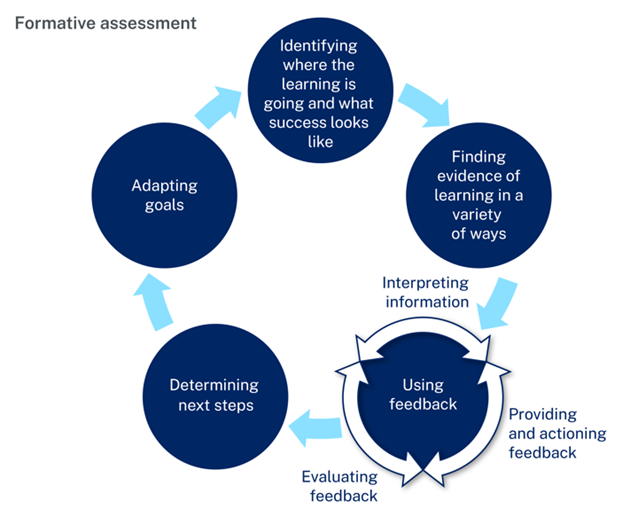
The question of which assessment resources will maintain the premise of appropriate, fair and inclusive assessment, often comes down to the distinction between formative and summative assessment. Formative assessment gathers ongoing evidence to guide teaching and learning,8 9 10 whereas summative assessment is a fixed-point judgement on achievement used for reporting.11 However, this divide is actually often less rigid than it first appears, as the same assessment can be used both formatively and summatively. A formative assessment can contribute to summative judgments, and likewise a summative test can function formatively as long as appropriate feedback is provided,9 though external, standardised assessments such as NAPLAN are used almost entirely summatively.12
Figure 1: Formative assessment Source: NSW Education Standards Authority (2026)
Student performance can vary by assessment type; students may reason clearly in collaborative, realistic problem-solving tasks but struggle to show the same depth in formal pen-and-paper tests, suggesting such tests are useful but don’t show the complete picture of student understanding.12 To accurately gauge where a student is at, teachers need multiple assessment strategies rather than relying on a single test result alone.
Black and Wiliam argue that assessment should be grounded in a belief that all students can achieve and focus on growth rather than competition between students.12 Formative assessment is a key tool for communicating this belief. Without it, feedback risks teaching low-achieving students that they simply lack ability. When teachers focus students on their own progress rather than assumptions about ability, they help remove bias from performance.
This bias reduction extends to involving students directly in assessment is an effective way of giving students ownership of their learning and providing deeper insights into their thinking. Self-assessment and peer-assessment are supported by research into Accessible Assessment for Learning (AAfL), which asserts that tools such as checklists and worked examples helped students move toward independent evaluation of their own work.14
Assessment strategies that would generally be considered formative assessment are actually some of the most effective for assessing the varied mathematics curriculua of today. Strategies such as extended investigations, collaborative problem-solving and verbalisations of thinking provide rich information about student thinking and attitudes, which is more appropriate than traditional pen-and-paper tests when assessing complex processes such as working mathematically and creative thinking.3 Triangulating information from multiple sources increases teachers’ confidence in their judgements and allows the different, often complex, components of mathematical learning to be assessed.8
Making these classroom-level shifts in how we understand assessment and student performance allows us to move past what Tai et al. describe as a tendency to view underperformance as ‘largely a problem of the student’ to be accommodated for.15 Adjustments for students are not a negative; however, if our immediate reaction is to overlook the assessment itself, then we risk missing the possibility that the task itself isn’t inclusive or appropriate.15
This reframing supports the AAMT’s recommendation that fairness is not achieved by adjusting for students after the fact, but by designing tasks that don’t introduce irrelevant barriers in the first place.3 This means assessment items should mirror classroom learning strategies rather than being unfamiliar. For standardised or high-stakes testing, this does not mean ‘teaching to the test,’ but ensuring students recognise the types of questions they encounter, so they can demonstrate what they know rather than spend time decoding what’s being asked.3
For classroom teachers, this means fair and inclusive assessment takes students’ backgrounds and experiences into account, framing assessment as a gauge of progress rather than a test of what students can’t do, thereby giving all students the opportunity for success. For assessment to be appropriate, teachers need to consider both its purpose and the bigger picture it provides of a student’s learning alongside other assessment strategies. Creating appropriate, fair and inclusive assessment doesn’t require a major overhaul. Everyday classroom strategies such as questioning, peer and self-assessment, worked examples, and teacher observation might not traditionally be considered assessment, but they serve the same underlying purpose: establishing where a learner currently is, where they’re going and what’s needed to get them there.9 16
How should maths assessment inform teaching and learning?
For assessment to be truly purposeful, it needs to lead to action. Clarke argues that every assessment should prompt teachers to ask how the information gathered will shape what happens next, for themselves, their colleagues, and their students.3 For students, feedback is more personal and typically answers three key questions: Where am I going? How am I going? and Where to next?17
Feedback can be considered one of the most powerful influences on achievement.17 Feedback is not simply telling a student whether an answer is right or wrong. It is information that narrows the gap between what a student currently understands and what they are aiming to understand.8
The importance of feedback in driving learning is evident in the guidelines and strategies curriculum authorities provide for effective feedback. NESA states that effective feedback needs to be timely, specific, and accessible.10 Feedback should identify concrete actions a student can take, treat misunderstandings as opportunities rather than failures and feed directly into future teaching decisions. AERO (2022) discusses this in practical terms, suggesting strategies such as whole-class feedback on common themes across the cohort, encouraging students to reflect on their answers and try again, and building in time for student self-reflection and teacher check-ins.18
As Sullivan et al. note, formative assessment and feedback function as a shared discussion between teachers and students.19 Teachers need to be able to articulate their intentions to provide clear guidance for students on the next steps in their learning.
This highlights the importance of feedback being planned as an integral part of the assessment cycle and not simply an add-on once assessment has been completed.20 By giving students genuine opportunities for reflection, and by staying flexible enough to focus teaching on what students actually need, assessment stops being a simple measure of where a student has been and instead becomes an active driver of where they are going next. ‘When assessments are used to guide future action, the ultimate intention is to promote learning’.3
What does purposeful maths assessment look like in practice? How can Maths Trek help?
All of this knowledge around assessment is excellent, but how can we put it in to practice in the classroom? The AAMT Towards Excellence in Teaching Mathematics in Australian Schools framework describes how excellent teachers assess their students’ learning.21
Excellent teachers of mathematics:
- use professional judgement to interpret evidence from research and practice
- recognise diversity as a strength and a starting point for mathematical learning
- design learning experiences with clear mathematical purpose
- orchestrate dialogue that values and builds on students’ mathematical thinking
- integrate assessment, feedback, practice, and consolidation to advance learning.21
The key aim of evaluation and assessment is to improve student learning and to plan future learning experiences. Current research paired with the AAMT’s shared professional vision ultimately reframes assessment as an ongoing pedagogical process rather than a single measure of achievement.3 21 This process needs to be responsive, equitable and oriented toward future learning. Maths Trek is designed to put this framework into teachers’ hands, embedding these principles into the everyday classroom.
You can read our Unpacking assessment in Maths Trek article for more detailed information on the various types and features of assessment throughout the program.
References
Hunter, J, Haywood, A, Parkinson, N, Daniel, P 2025, The Maths Guarantee: How to boost students’ learning in primary schools, Report, Grattan Institute, viewed 19 October 2026, https://grattan.edu.au/report/maths-guarantee/↩
Australian Curriculum, Assessment and Reporting Authority (ACARA) 2026, Latest NAPLAN data shows improvements in national numeracy levels alongside areas for continued attention, Media release, 5 August 2026, viewed 7 October 2026, https://www.acara.edu.au/docs/default-source/media-releases/media-release-latest-naplan-data-shows-improvements-in-numeracy-levels-alongside-areas-for-continued-action-5-8-26.pdf↩
Australian Association of Mathematics Teachers (AAMT) 2017, The practice of assessing mathematics learning, Position Paper, viewed 19 October 2026, https://aamt.edu.au/wp-content/uploads/2020/07/Assessment_position_paper_2017.pdf↩
Australian Curriculum, Assessment and Reporting Authority (ACARA) 2026, Aligning curriculum and assessment, viewed 19 October 2026, https://www.australiancurriculum.edu.au/resources/curriculum-leadership/eight-aspects-of-curriculum-planning/aligning-curriculum-and-assessment↩
NSW Education Standards Authority (NESA) 2026, Assessment principles, viewed 15 October 2026, https://curriculum.nsw.edu.au/assessment-and-reporting/assessment-principles↩
Queensland Curriculum and Assessment Authority (QCAA) 2013, Appendix 2: Principles of assessment, https://www.qcaa.qld.edu.au/downloads/p_10/ac_principles_ass_append2.pdf↩
Faragher, R, Hill, J, & Clarke, B 2016, ‘Inclusive practices in mathematics education’, in K Makar, S Dole, J Visnovska, M Goos, A Bennison & K Fry (eds), Research in mathematics education in Australasia 2012-2015, Springer, pp. 119-141, https://www.researchgate.net/publication/303772428_Inclusive_Practices_in_Mathematics_Education↩
Dayal, HC 2021, ‘How teachers use formative assessment strategies during teaching: Evidence from the classroom’, Australian Journal of Teacher Education, vol. 46, no. 7, https://doi.org/10.14221/ajte.2021v46n7.1↩
Black, P & Wiliam, D 2009, ‘Developing the theory of formative assessment’, Educational Assessment, Evaluation and Accountability, vol. 21, no. 1, pp. 5-31, https://www.researchgate.net/publication/225590759_Developing_the_theory_of_formative_assessment↩
NSW Education Standards Authority (NESA) 2026, Formative assessment, viewed 15 October 2026, https://curriculum.nsw.edu.au/assessment-and-reporting/formative-assessment↩
NSW Education Standards Authority (NESA) 2026, Summative assessment, viewed 15 October 2026, https://curriculum.nsw.edu.au/assessment-and-reporting/summative-assessment↩
Black, P & Wiliam, D 1998, ‘Inside the black box: Raising standards through classroom assessment’, Phi Delta Kappan, vol. 80, no. 2, pp. 139-148, https://www.michigan.gov/-/media/Project/Websites/mde/Year/2017/09/18/Inside_The_Black_Box_-_Black_and_William.pdf↩
NSW Education Standards Authority (NESA) 2026, Formative assessment, viewed 15 October 2026, https://curriculum.nsw.edu.au/assessment-and-reporting/formative-assessment↩
Queensland University of Technology, Centre for Inclusive Education (C4IE) 2026, Results: Stories of impact, AAfL in English and maths, viewed 15 October, https://research.qut.edu.au/aafl/results/↩
Tai, J, Ajjawi, R, Bearman, M, Boud, D, Dawson, P & Jorre de St Jorre, T 2022, ‘Assessment for inclusion: Rethinking contemporary strategies in assessment design’, Higher Education Research & Development, vol. 42, no. 2, pp.483-497, https://doi.org/10.1080/07294360.2022.2057451↩
NSW Education Standards Authority (NESA) 2026, Evidence and feedback, viewed 15 October 2026, https://curriculum.nsw.edu.au/assessment-and-reporting/evidence-and-feedback↩
Hattie, J & Timperley, H 2007, ‘The power of feedback’, Review of Educational Research, vol. 77, no. 1, pp. 81-112, https://www.researchgate.net/profile/Nurhanis-Roslan-2/post/Im_searching_for_a_short_article_that_explains_the_value_of_feedback_feed_forward/attachment/ 59d64f6279197b80779a888a/AS:497433086234625@1495608697734/download/power-feedback.pdf↩
Australian Education Research Organisation (AERO) 2022, Formative assessment: Gathering and interpreting information to progress student learning, viewed 19 October 2026, https://www.edresearch.edu.au/summaries-explainers/explainers/formative-assessment↩
Sullivan, P, Clarke, DJ, Clarke, DM, Farrell, L & Gerrard, J 2013, ‘Processes and priorities in planning mathematics teaching’, Mathematics Education Research Journal, vol. 25, no. 4, pp. 457-480, https://doi.org/10.1007/s13394-012-0066-z↩
Australian Curriculum, Assessment and Reporting Authority (ACARA) 2026, Aligning curriculum and assessment, viewed 19 October 2026, https://www.australiancurriculum.edu.au/resources/curriculum-leadership/eight-aspects-of-curriculum-planning/aligning-curriculum-and-assessment↩
Australian Association of Mathematics Teachers (AAMT) 2026, Towards excellence in teaching mathematics, viewed 19 October 2026, https://aamt.edu.au/wp-content/uploads/2026/05/TOWARDS-EXCELLENCE-IN-TEACHING-MATHEMATICS-10.pdf↩